
The Moment Every Hiker Hits a Wall on the Trail
There’s a point in almost every Hiking journey where the trail stops feeling enjoyable and starts feeling like a test of endurance. It usually happens halfway through a long climb or during a steep descent when your knees begin to ache, your footing becomes less stable, and every step feels heavier than the last.
This is the moment many hikers misread as “just getting tired.” But in reality, it’s often a gear and support problem—not a fitness problem.
Uneven terrain, loose gravel, steep drop-offs, and long distances all combine into a silent strain on your body. Without proper support, your legs absorb every bit of impact, and that fatigue builds faster than expected.
The solution isn’t to hike less. It’s to hike smarter.
Field Reality: What Actually Breaks Down First on the Trail
When hikers struggle on difficult terrain, it’s rarely just one issue. It’s a chain reaction:
- Knees absorb excessive shock on downhill sections
- Ankles constantly adjust to unstable ground
- Posture weakens as fatigue sets in
- Energy drops due to inefficient movement
- Balance becomes harder to maintain with a loaded backpack
Most hikers don’t notice these factors individually. They just feel “exhausted.” But the real problem is mechanical stress accumulation.
On technical trails, especially in mountainous or forested Hiking routes, your body is working overtime just to stabilize itself. That’s where support tools like trekking poles become critical—not optional.
The Survival Advantage: Why Trekking Poles Change the Game
In real trail conditions, trekking poles function like an extra set of limbs. They don’t just help you walk—they help you survive long-distance fatigue and unstable terrain more efficiently.
What changes immediately when you use trekking poles:
- Impact on the knees during descents is significantly reduced
- Stability improves on slippery or uneven ground
- The upper body shares part of the workload
- Balance recovery becomes faster during missteps
- Overall endurance increases over long hikes
Instead of your legs absorbing 100% of the effort, the load gets distributed across your arms, shoulders, and core. That shift alone can extend your Hiking range dramatically.
Common Misconception: “Trekking Poles Are Only for Difficult Climbs”
One of the biggest misunderstandings in Hiking culture is that trekking poles are only useful for extreme or advanced trails.
In reality, they’re most valuable in exactly the conditions most hikers face:
- Long forest trails with constant elevation changes
- Wet or muddy paths where slipping is common
- Rocky terrain requiring constant balance correction
- Downhill routes that strain knees and joints
- Multi-hour hikes where fatigue compounds over time
Even moderate hikes become significantly more comfortable with proper support. The difference isn’t just physical—it’s psychological. You move with more confidence, which reduces hesitation and energy waste.
Choosing the Right Trekking Setup: Stability vs Portability
Not all hikers need the same type of trekking pole. The right choice depends on how you approach hiking.
If your priority is impact reduction and joint protection, especially on downhill-heavy trails, anti-shock technology is a major advantage. It absorbs sudden force and softens each step, reducing long-term strain on knees and wrists.
If your focus is on travel convenience and lightweight packing, folding designs are ideal. They collapse quickly, store easily in backpacks, and are perfect for hikers who move between different terrains or travel frequently.
Both approaches solve the same core issue: improving stability and reducing fatigue on the trail.
Product Solutions Designed for Real Hiking Conditions
To address these trail challenges effectively, two trekking pole options stand out for their practical design and field-tested utility.
Ultralight Anti-Shock Trekking Pole
Built for hikers who frequently encounter steep descents and uneven terrain. The anti-shock mechanism helps reduce impact forces that typically travel directly into the knees and joints. This makes it especially valuable for longer Hiking sessions where fatigue and strain build over time.
Explore here:
https://sasquatchoutdoorproducts.com/product/ultralight-anti-shock-trekking-pole/
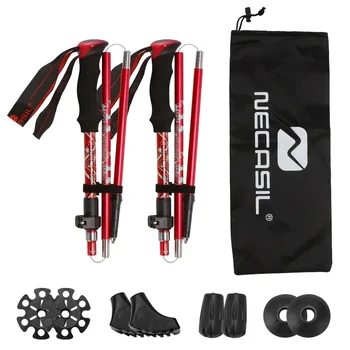
Ultralight Folding Trekking Poles
Designed for hikers who prioritize portability without sacrificing stability. These poles fold down compactly, making them easy to carry in backpacks while still offering strong support on varied terrain. Ideal for multi-location Hiking trips or minimalist outdoor setups.
Explore here:
https://sasquatchoutdoorproducts.com/product/ultralight-folding-trekking-poles/
Both products are built around a simple principle: reduce physical strain so you can stay on the trail longer, safer, and more comfortably.
What Experienced Hikers Understand That Beginners Often Miss
With enough time on the trail, most hikers eventually realize something important: endurance is not just about fitness—it’s about efficiency.
The less unnecessary energy your body wastes on balance, impact absorption, and posture correction, the farther you can go.
Trekking poles don’t make the trail easier. They make your movement smarter.
They help you:
- Maintain rhythm instead of reacting to terrain
- Reduce recovery breaks caused by fatigue
- Stay stable even when conditions shift unexpectedly
- Finish long Hiking routes with more energy left in reserve
That’s the real advantage—not speed, but sustainability.
Hiking Should Be Challenging, Not Punishing
Every trail has its demands, but your body shouldn’t carry those demands alone. When support tools like trekking poles are used correctly, they don’t just improve comfort—they change how you interact with the entire Hiking experience.
You move with more control. You last longer. You recover faster. And most importantly, you stay confident even when the terrain isn’t predictable.
Take Your Next Step on the Trail with Better Support
If you’re ready to make your Hiking experience more stable, efficient, and less physically taxing, it’s time to upgrade your gear.
Explore trekking solutions built for real outdoor conditions here:
https://sasquatchoutdoorproducts.com/shop/



0 Comments